
June 10, 2026

Data-driven content doesn't reliably earn more links than a good guide. But the links it does earn are a different quality entirely.


"Data-driven content earns more backlinks." You've heard it (and maybe said it yourself) a hundred times. The claim feels intuitive, and it's a helpful nugget to pull out when asking for more budget. There's just one small issue: we didn't know whether the claim was true or not.
So the Campfire team decided to test it. We pulled live backlink data from Ahrefs across eight well-known (and randomly selected) B2B SaaS domains—Ahrefs, Ramp, Brex, Carta, Lattice, Gong, Klaviyo, Salesloft—and classified over 70 of their most-linked editorial pages into two buckets:
Then we compared how many referring domains each bucket earned per month, and how good those linking domains actually were, judged by domain rating.
At the risk of sounding clickbaity, we were surprised at what we found. On raw link volume, data-driven content does not reliably drive more backlinks. But on link quality, it wins decisively.
Let's start with the headline number. Across all 70+ pages, data-driven content earned a median of 15.9 new referring domains per month. Standard content earned 9.7. Case closed, right? Data wins by 64%.
Buttttt… almost every data-driven page in the sample comes from two of the highest-authority sites we looked at—Ahrefs (Domain Rating 91) and Klaviyo (DR 92). These are companies whose content engine is built on proprietary data. Of course their research pages rack up links! They're sitting on DR 90+ domains and they've spent years training the market to cite them.
To ensure our results aren't unduly skewed by these two big players, we ran the numbers again with the lower DR sites in our sample.
In the mid-authority band (domains under DR 82, which describes the majority of B2B SaaS company sites) standard content earned more referring domains per month than data-driven content: a median of 9.5 versus 4.5. A well-crafted how-to guide can outperform original research on referring domains by more than two to one.

So if your content goal is to maximize the count of domains pointing at your site, a sharp standard guide aimed at a high-intent query is competitive with original research, particularly for medium-authority B2B sites.
But we'd argue that volume of backlinks and/or referring domains is the wrong metric to chase.
Campfire Labs can help you create data-driven content like the piece you're reading now. Book a call with us.
Counting referring domains treats every link as equal, and in reality, links are pretty unequal. A citation from a DR 70 industry publication and a link from a DR 3 scraper site that spun your headline have very different value for your site.
To understand whether different content types impacted link quality, not just quantity, we took five matched page pairs (one data page and one standard page on the same domain) and pulled the authority distribution of the linking domains. This time, the data-driven content showed up as the stronger asset immediately: the median authority for sites linking to data content across our sample was around 60 DR; for sites linking to non-data content, the median authority went down to just 1.
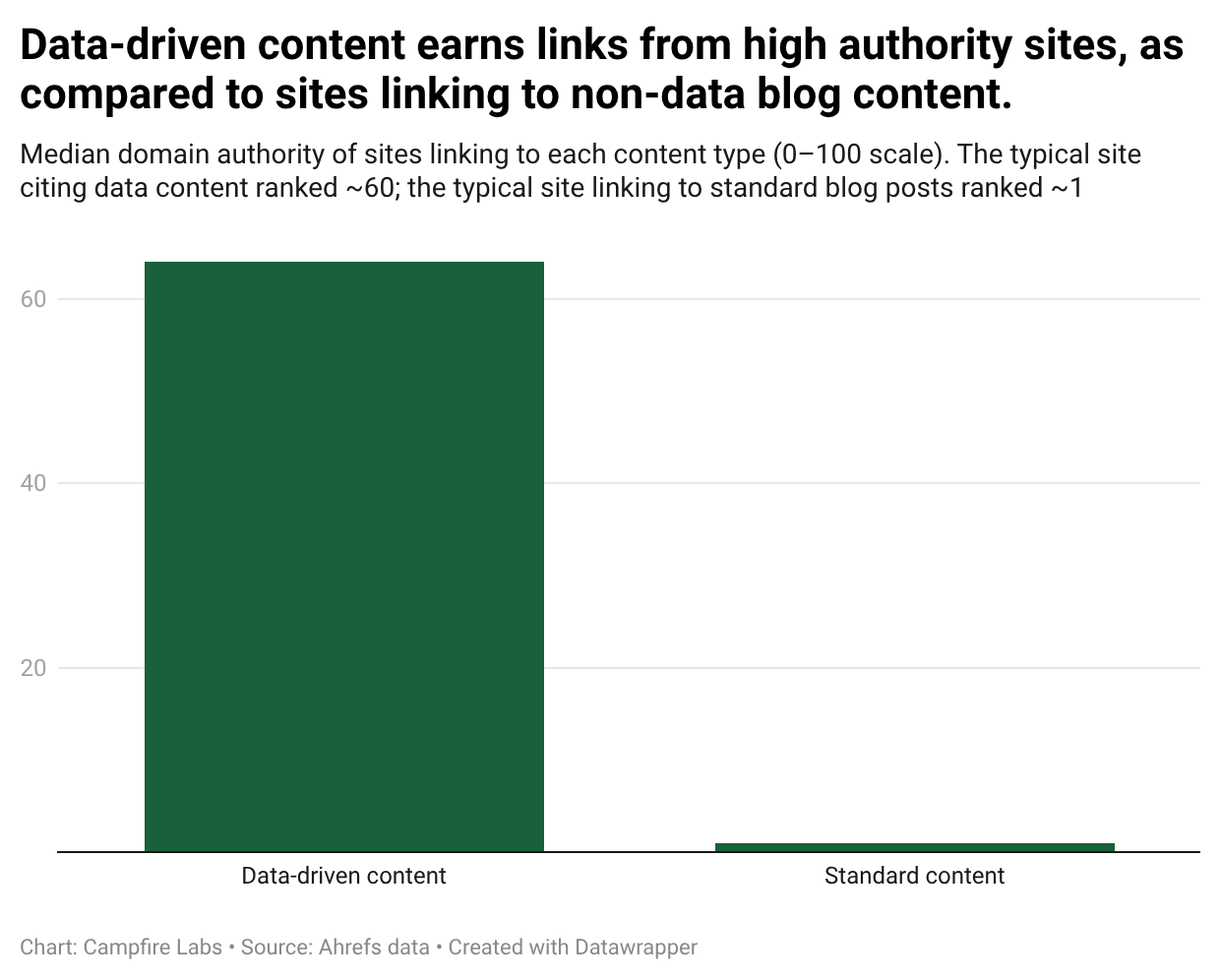
Even measured by the average rather than the median, data content pulled domains roughly twice as authoritative.
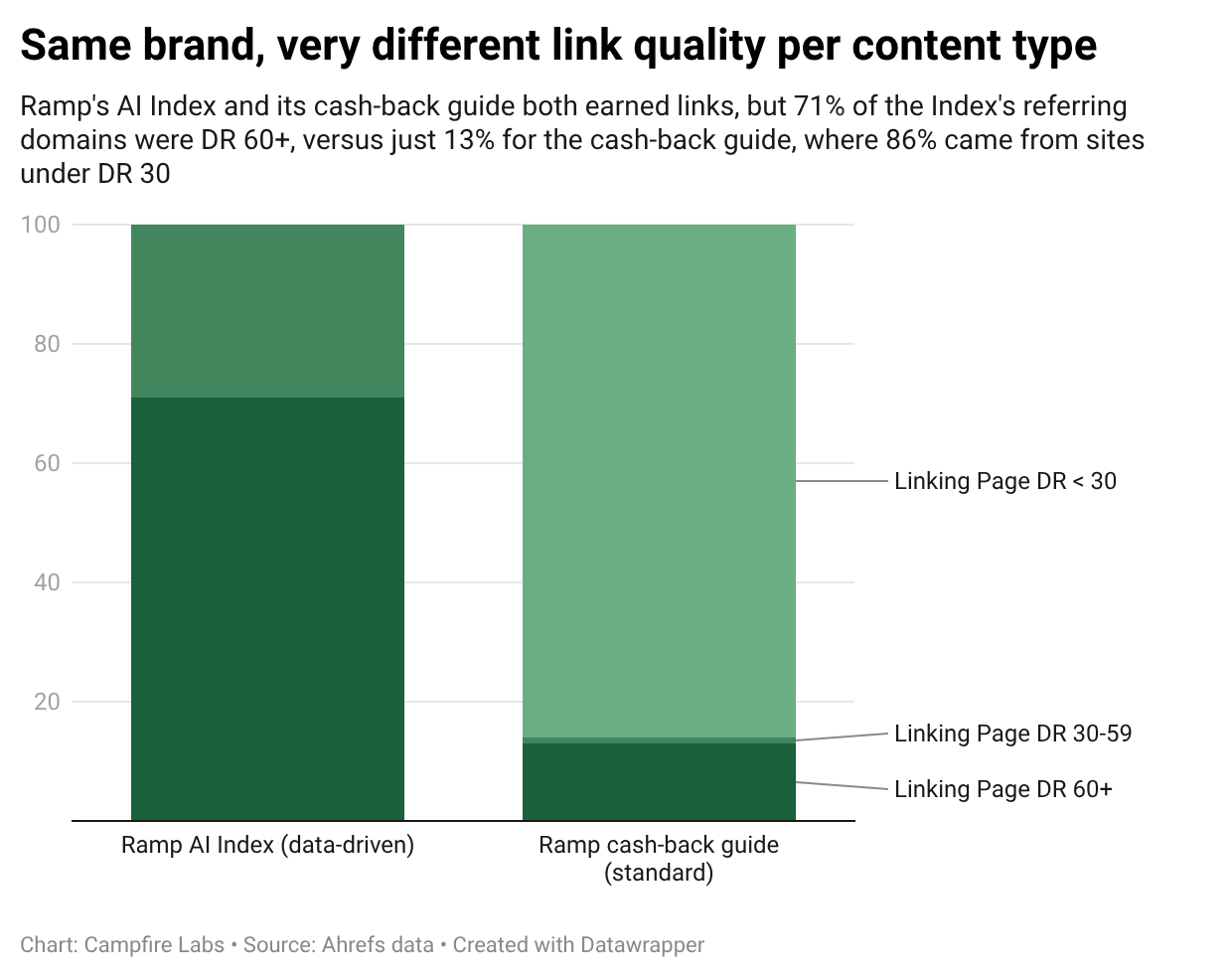
Ramp illustrates our point. We compared their AI index to their cash-back credits guide: the Index drew links with a median Domain Rating of 70. Seventy-one percent of its referring domains were DR 60 or higher, made up of heavyweight publications. Ramp's cash-back-credit-cards guide, which earned far more raw links, drew a median linking-domain DR of zero. Eighty-six percent of its referring domains were under DR 30.
Same for Carta. Its founder-ownership research pulled a median linking DR of 29; its market-cap explainer pulled a median of roughly 1, with 94% of links coming from domains under DR 30 and 96% of them nofollow. So while the non-data content page "won" on volume of links, there were a lot of low authority backlinks in there.
And finally, we ran the same test on Lattice's State of People Strategy report vs its AI tools listicle. The former has a median linking DR of 35, compared to the listicle's median DR of about 1, with 89% of links under DR 30.
Admittedly our sample size is just a handful of pages, but it indicates that data-driven content earns higher quality referring domains, even in the cases where it earns fewer total links.
Campfire Labs can help you create data-driven content like the piece you're reading now. Book a call with us.
The quality gap is large but not universally so. It showed up most where the standard page we analyzed was 'commodity content': SEO guides and glossary explainers with little information gain for the reader. It shrank (or even vanished) when the standard page was itself a strong, widely respected asset.
For example, Ahrefs' how-to guide on keyword research drew a linking profile essentially identical to its original search-traffic study; both pulled from a sea of DR 85+ domains, because an authoritative how-to guide on an authoritative domain earns just as well as research does.
So the rule isn't "data good, guides bad." We'd characterize it as, "data-driven content reliably beats commodity content on link quality. Against genuinely excellent standard content, there's less of a difference." Perhaps the lesson isn't really about format at all, but whether the thing you made is worth citing.
This is observational, correlational research across a small sample, and there are a few caveats in our methodology:
Neither of these negates the central finding. It just means that in this small sample, weighted by linking-domain authority, data-driven content drove higher quality links, not higher volume of links. If anyone would like to take our initial hypothesis and test it at a larger scale, we'd love to see that happen.
Six questions to help you create your own data-driven content.
If you've been justifying your research budget with "data content earns more backlinks," consider changing the pitch. The defensible argument is that original research earns high-authority editorial citations that compound into domain authority and brand credibility over time.
In terms of success metrics, we'd also suggest reporting the authority distribution of your links. A piece that earned 40 citations with a median linking DR of 50 beats a piece that earned 200 at median DR of 2.
Original data isn't a magic backlink machine (sadly!). It's an authority play, and it pays off most when the rest of your content doesn't drive brand authority. So while data-driven content doesn't necessarily get you more links, it does give you a chance to get better links.
(For more on when SEO content still earns its keep, our look at whether SEO is actually dead ran the same kind of sceptical-data test and reached another surprise conclusion.)
Subscribe to our newsletters for insights, ideas, and perspectives from the brightest minds in marketing, delivered straight to your inbox.
