

March 24, 2026
Real-world B2B SaaS pillar page examples from top SaaS companies.

This article is part of a series in which we round up great examples of classic types of content. Check out our B2B content examples, case study examples, benchmark report examples, content strategy examples, or thought leadership examples.
Most B2B SaaS content teams treat "pillar page" as a deliverable. Write it long, structure it well, link to it everywhere. Done.
But a pillar page is a strategic decision before it's a content format. The same keyword could be answered with a 9,000-word educational guide, a product-led resource hub, or a tight thought leadership piece anchored by proprietary data. The approach you choose should depend on where your buyer sits, what the keyword intent signals, and what role you want the page to play in your funnel.
The four pillar page examples below show how differently this plays out in practice. Each represents a distinct pillar page archetype with its own structural logic and ideal use case.
Book a call with our CEO to discuss your organic acquisition goals and see how Campfire Labs can develop and execute a content strategy for your business.
A pillar page is a long-form piece of content built to be the primary reference for a topic on your site. It's typically anchored to a high-volume keyword, structured to rank, and surrounded by a cluster of supporting articles that link back to it. The rise of AI search hasn’t changed those fundamentals (yet!).
What separates a pillar page from a long blog post isn't length, but rather intent. Pillar pages are built to own a topic, not just cover it. They're the hub of your content ecosystem for a given subject, and they signal to search engines that your site has genuine authority over that territory.
That said, "pillar page" isn't a single thing. It's a category with several distinct types, and the differences between them matter more than most teams realize.
Fair question! If AI Overviews are absorbing more zero-click queries, and tools like ChatGPT are changing how people find information, why on earth invest in building out a 4,000-word pillar page?
Because SEO still drives the majority of organic traffic for most B2B SaaS sites, and pillar pages have quietly become more, not less, important for how that traffic gets found.
Google's AI-powered search is more intent-aware than ever. It doesn't just match keywords; it tries to understand the relationship between topics. A well-built pillar page, surrounded by a cluster of supporting articles that link back to it, gives Google a clear map of what your site knows and how deeply it knows it. That topical authority is one of the factors for which sites surface in AI-generated summaries and traditional results alike.
There's also the internal linking advantage. Pillar pages act as a structural hub for your content, a central node that distributes link authority outward to cluster articles and pulls readers deeper into your site. In a content ecosystem without that hub, crawlers have to work harder to understand what your site covers, and readers have fewer natural paths to follow.
None of that means you can publish a 10,000 word skyscraper blog and watch the traffic role in. In 2026 it’s about choosing formats that match buyer intent, embedding proprietary data where you can, and treating the pillar as a living asset rather than a one-time publish. The format isn't the problem. Treating it as a checkbox is.
The setup: Airmeet, a virtual events software company needed to rank for a broad, high-volume informational keyword. Their audience was event marketers who had heard of virtual events but didn't yet know whether they needed a dedicated platform to run one.
What they built: A comprehensive, everything-you-need-to-know pillar page covering the definition, types, pros and cons, hosting advice, and real-world examples of virtual events. The page includes comparison tables, expert tips sourced from practitioners, and a full breakdown of virtual versus in-person formats.
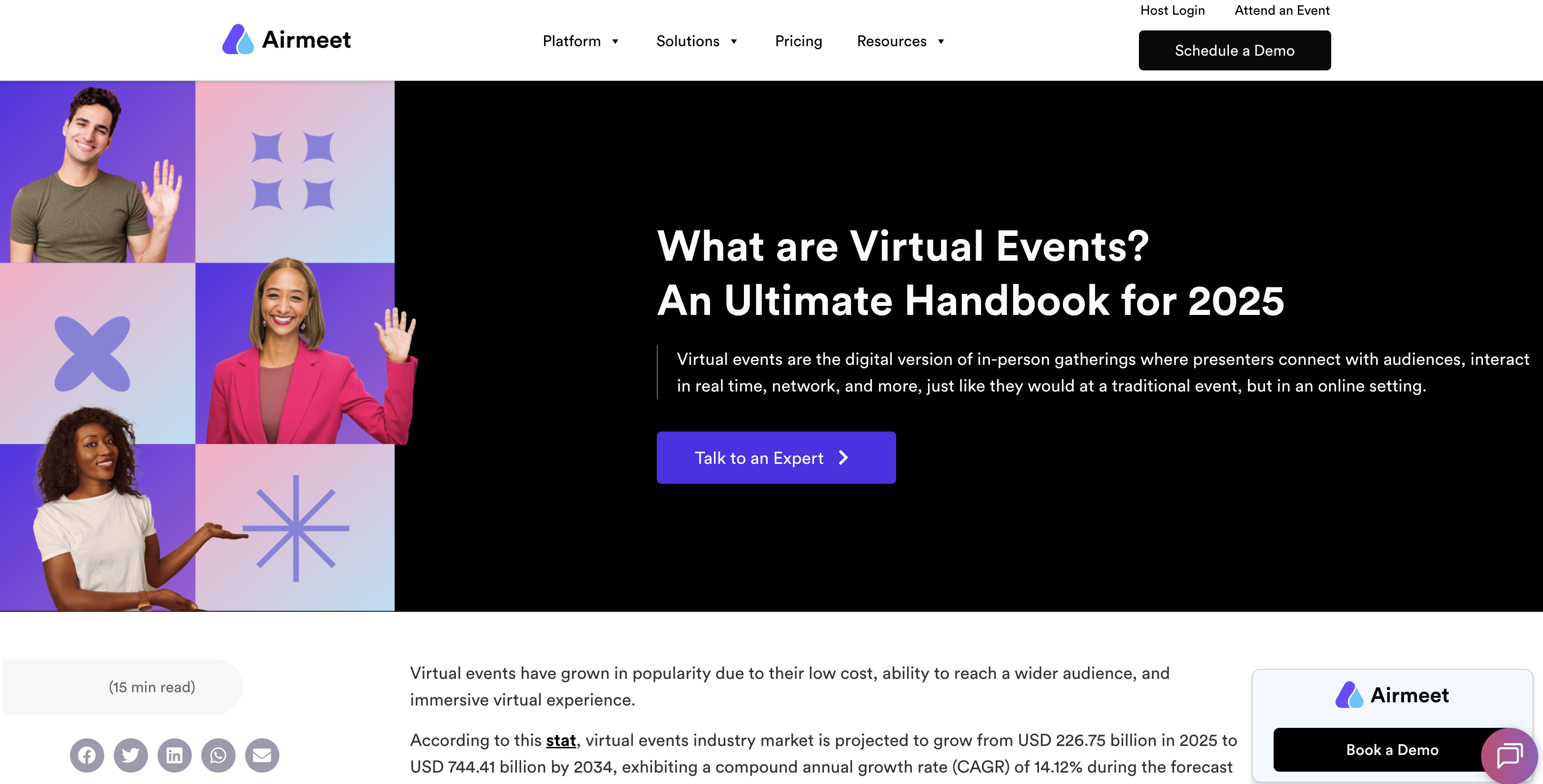
What makes it work: This page earns its position through sheer comprehensiveness. It answers every question a first-time reader might have, ensuring there's no reason to look elsewhere for information. The structure is almost encyclopaedic: scannable headings, short sections, tables for quick comparisons, and a clear "this is the definitive guide" presentation. There's no hard sell. The product barely appears. The page’s job is to become the trusted resource that precedes conversion.
Ideal use case: Create this kind of pillar page for top-of-funnel informational keywords where a significant portion of your potential customers are still researching the problem space. This format works particularly well for software categories where most people don't know they need a dedicated tool yet, they're just trying to understand the topic. Don't expect this page to convert directly. Expect it to build the awareness that makes the rest of your funnel work.
The setup: Vena, a financial planning software company, needed to rank for a keyword tied to a challenge their buyers frequently face, but rarely Google in product terms. Rather than targeting a "what is" query or a tool comparison keyword, they identified a problem their audience needed help thinking through.
What they built: A narrative-driven pillar page exploring the psychology behind why change initiatives fail, the unique pressures a particular professional audience faces when adopting new technology, and a proprietary six-step framework for driving successful transformation projects. The page reads more like a consultative guide than a typical SaaS marketing piece — and deliberately so.

What makes it work: This format does something most B2B content doesn't: it meets buyers where they actually are, not where the product wants them to be. By addressing the human side of a technical problem—resistance, cognitive biases, organisational dynamics—the page builds credibility before a single product feature is mentioned. The proprietary framework (named and branded) gives the content something memorable and shareable. Importantly, the product appears only at the end, positioned as the natural conclusion to the problem being solved.
Ideal use case: Create this kind of pillar page for complex B2B categories where buying your product requires significant internal change: budget approval, team adoption, process overhaul. If your buyers need a mindset shift before they'll even evaluate solutions, this format turns your pillar page into a consultative asset rather than a sales document. It's especially effective when your ICP is a senior decision-maker who considers themselves well-informed and would be put off by a page that leads with product messaging.
The setup: Subscription billing platform Recurly wanted to target a high-intent commercial keyword, the kind where someone searching it is actively evaluating solutions, not just learning about the topic.
What they built: A hybrid landing page and resource centre. The pillar page opens with a product-led overview of what they offer and why it matters, then moves into FAQs structured around the questions buyers ask before choosing a tool, key performance statistics, and links to related guides, webinars, and case studies. CTAs are woven throughout rather than saved for the end. The tone is confident and product-forward from the first paragraph.

What makes it work: This format respects the buyer's intent. Someone searching a commercial-intent keyword doesn't want a 5,000-word primer; they want to know what good looks like, how you deliver it, and whether you're credible enough to trust. The FAQ structure is particularly smart for SEO: each question maps directly to a query people type when they're close to a buying decision, which earns featured snippet placements and pulls in long-tail traffic alongside the primary keyword. Social proof (statistics, named clients, recovery rates) does the heavy lifting where product claims alone can't.
Ideal use case: Keywords with strong commercial intent, where the reader is already solution-aware and evaluating their options. This format converts better at the bottom of the funnel than a purely educational pillar. That said, it requires you to have something credible to showcase. It's weak if you're an early-stage company without proof points; powerful if you have data, case studies, and a clear, differentiated product story.
Book a call with our CEO to discuss your organic acquisition goals and see how Campfire Labs can develop and execute a content strategy for your business.
The setup: Klaviyo is a B2C marketing platform with a broad, competitive topic to own, and the resources to build a proper content ecosystem around it, not just a single page.
What they built: One of four interconnected pillar pages, each targeting a different angle of the same broad topic. This particular page takes a customer service lens: how a specific strategy applies to support teams, not just marketers. The page is built on proprietary research data from Klaviyo's own annual benchmark report, structured around benefits, and cross-links aggressively to sibling pillar pages in the series, with a content grid at the bottom pointing readers to the related guides.

What makes it work: A single pillar page can rank for one keyword. A series of four interconnected pillar pages can own a topic cluster, building topical authority across dozens of related keywords while each page reinforces the others' SEO strength through internal linking. The use of proprietary research throughout makes this content genuinely unique: no one else can write the same article, which earns backlinks, builds brand authority, and keeps the content from dating quickly. The cross-linking grid at the bottom is also a smart UX move, as it keeps readers in the ecosystem rather than bouncing back to search.
Ideal use case: Companies with the content budget to build at least two to four connected pages, and a broad, high-value topic worth owning systematically. This works particularly well when you have original research or data to embed throughout. If you build just one page in this format without the surrounding cluster, you lose most of the strategic advantage; the series effect is the point.
The format should follow the strategy, not the other way around. Three questions will point you toward the right approach:
What's the buyer's intent behind the keyword? Informational intent (someone learning about a topic) suits the comprehensive guide or evergreen authority format. Commercial intent, when someone is evaluating solutions, suits the resource hub. Problem-awareness intent (someone who knows they have a challenge but isn't sure how to solve it) suits the problem education pillar. Building around a topic area, not a single keyword? That's the cluster pillar.
What does your buyer need to believe before they'll buy? If they need to understand the category, lead with education. If they need to trust your expertise, lead with thought leadership and frameworks. If they need proof you can deliver results, lead with data and case studies.
What resources do you have to maintain it? The evergreen and cluster formats only deliver their full value if you treat them as ongoing assets. If your content team can publish but can't commit to quarterly updates and cluster expansion, a well-executed resource hub or problem education pillar will outperform an ambitious mega-guide that gradually falls behind.
The most common pillar page mistake in B2B SaaS is producing the right content for the wrong format. When you start with the question "what does this buyer need, and what does this keyword signal?", the format almost answers itself.
If you want to create solid pillar pages that drive organic traffic and influence LLMs (like the ones above), reach out to us at Campfire Labs.
Subscribe to our newsletters for insights, ideas, and perspectives from the brightest minds in marketing, delivered straight to your inbox.
