

June 29, 2026
The content brief template we use with Notion, Dropbox, and Asana — built for thought leadership, not SEO. No email required.

This article is part of a series in which we share the content templates we use with some of B2B SaaS's biggest companies. Check out our content strategy template here.
The brief is the most important document in your content process, and it's usually the worst one.
Many of the content briefs we see as an agency are SEO worksheets wearing a trench coat. Target keyword, search volume, word count, alist of H2s lifted from whatever's ranking on page one, three "people also ask" questions... Hand that to a writer and you'll get back something technically complete and completely forgettable, a piece that says what twelve other pieces already said, just rearranged.
We've written editorial content for B2B SaaS superstar companies like Notion, Dropbox, Asana, Lattice, and Freshworks. Across all those experiences, the thing that most reliably separates a piece that lands from a piece that disappears isn't the writer, the topic, or the budget.
It's the brief.
So we're giving ours away! We're sharing the actual content brief template we fill out before we write anything for the world's biggest B2B SaaS brands, and you don't even have to give us your email address.
View and copy the template here.
One thing up front: this is not an SEO brief. It won't tell you where to put your keyword. It's built to get everyone aligned on the story before writing gets started.
The old SEO playbook was the skyscraper: find the top-ranking article on a keyword, make yours longer, add more subheadings, cover more sub-questions, and out-comprehensive the competition. Aggregate everything anyone ever said about a topic into one definitive-looking page. It worked! Google rewarded it, and the brief that fed it—keyword, outline, word count—was all you needed.
Then generating that exact kind of content became free.
Anyone can now produce a 2,500-word, well-structured, keyword-aligned aggregation of the existing internet in about ninety seconds. The skyscraper isn't a moat anymore; it's a commodity. When the marginal cost of producing competent, comprehensive, derivative content drops to zero, competent-comprehensive-derivative stops being effective.
So the value relocated to the things AI can't scrape: a genuine point of view, an idea your competitors don't have, proof that comes from your product and your customers, a brand that sounds like someone. The same shift is happening in how content shows up inside AI answers themselves: models surface sources with a distinct, citable perspective, not the fourteenth rewrite of a listicle.
A brief built to produce skyscrapers struggles to produce a differentiated thought leadership editorial. You cannot keyword-and-outline your way to a point of view, sadly. The brief has to ask different questions.
Book a call with our CEO to discuss how we can help you create content.
Most bad content isn't badly written. It's badly aligned: the writer guessed at the angle, the stakeholder had a different one in their head, and three revision cycles (and endless feedback sessions) later, you've sanded the piece down into something safe and pointless. A good editorial brief forces a conversation between the stakeholder who has the idea and the writer who has to execute it, and requires that they align on a differentiated POV before anyone starts drafting.
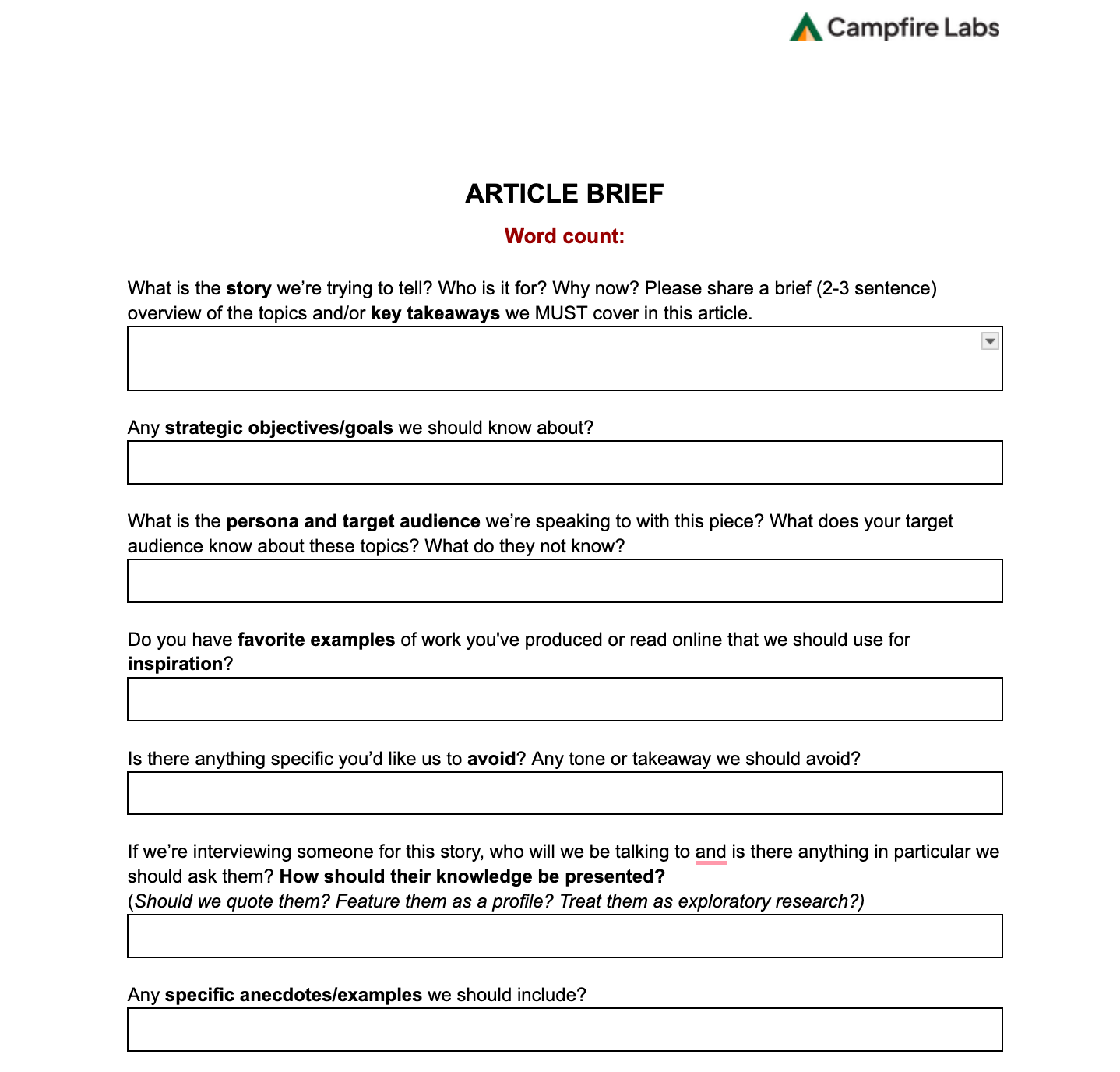
Every field in our content brief template is there to answer one of three questions: What's the story? Who's it for? Why are we the right people to tell it, right now?
Here's what we actually fill out, and why each piece earns its place.
The story. What are we telling, who is it for, and why now? We require whoever owns the piece to write 2–3 sentences on the core takeaway the reader must walk away with. If you can't write those sentences, the piece isn't ready to brief, and no amount of word count will save it.
Strategic objective. What is this piece supposed to do for the business? Build authority in a new category, support a launch, give sales something to send. Naming the objective keeps the writer from optimizing for the wrong success metric, and it's how you defend the piece later when someone asks what it was for.
Persona and knowledge gaps. Who's reading, and what do they already know versus what don't they know? The fastest way to sound generic is to explain things your reader mastered years ago. The fastest way to lose them is to assume knowledge they don't have. Our brief requires that you really think about your reader and their information needs.
Inspiration and things to avoid. Examples of work (yours or anyone's) that capture the register you want. And an explicit list of tones, takes, or clichés to stay away from. This is our effort to get style tics out in the open before anyone sees a draft.
How to handle the expert. If there's an interview, who is it with, what should we ask, and how should their knowledge show up (a direct quote, a full profile, or background research that informs the piece without being attributed?) Deciding this before the interview changes the questions the writer asks.
Anecdotes, links, and existing material. The specific stories, proprietary data, internal docs, and prior content the writer should pull from. In our experience, this section is a goldmine for brand differentiation. The product details and customer moments in here are exactly what make the piece yours.
The call to action. What should the reader do next? One field, but naming it early stops the piece from ending in a vague shrug.
Timeline and workback. Your ideal launch date, working backward through drafting, review, and edits. We build ours against our editorial standards so nothing gets compressed into a rushed final pass.
Headlines. Before drafting, we write 2–3 working headlines for how we'd frame the story. Not for SEO — for clarity. If you can write a sharp, specific headline, you have an angle. If every headline comes out mushy, you've found your problem before you've spent a draft on it.
Zoom out from the brief with these content strategy examples for different B2B models.
"This is a lot of fields for one blog post." Fair, maybe. But our perspective is that the brief isn't "extra" work; it's relocated work.
Every minute you spend here is a minute you don't spend in revision hell, rewriting a draft that went the wrong direction because nobody was aligned. A tight brief is the difference between one round of edits and four.
You don't have to fill every field every time. The non-negotiables are the story, the persona's knowledge gaps, and the headlines; those three force the thinking that prevents generic output. The rest are situational. A data report leans hard on the anecdotes-and-material field; a quick reactive piece might skip the formal interview section entirely. Use judgment. The template is a checklist for thinking, not a form to satisfy.
We wrote about how the strongest content teams are splitting their strategy into two deliberate lanes, and a brief like this is how you keep the thought-leadership lane from collapsing back into commodity.
Grab the template here. Don't fill out the whole thing for your next piece. Just write the story field: 2–3 sentences on what you're telling, who it's for, and why you're the one to say it.
If those sentences come easily, you're ready to write. If they don't, you just caught a weak piece before it cost you a draft, which is the entire point of a brief.
Book a call with our CEO to discuss how we can help you create content.
Subscribe to our newsletters for insights, ideas, and perspectives from the brightest minds in marketing, delivered straight to your inbox.
