
July 20, 2026

Steal the strategy deck we use with some of B2B SaaS's biggest names, free.


This article is part of a series in which we share the content templates we use with some of B2B SaaS's biggest companies. Check out our content brief template here.
I've seen content strategy templates that are just a table of contents pretending to be a plan. Personas here, pillars there, a channel matrix, a mission statement about "being the trusted voice in the category." Fill in the blanks, and you've got a document that looks like a strategy and functions like a chocolate teapot.
The template we actually use with clients works differently. It starts from a business barrier and requires that all sections exist to break down that barrier. Every pillar traces back to a revenue goal, and messaging ties back to an objection that's costing deals. Crucially, we diverge from the template when we need to, and any template you use has to be flexible enough to allow for that.
Below, we're sharing the full template for free, no email required. It outlines the six strategic sections we build for every content plan and the why behind each. You can copy the blank version and fill it in for your own program.
View and copy the template here.
To keep it concrete, this blog post will run through the template through the lens of a hypothetical B2B SaaS company we'll call Kestrel. This is not a real client of ours! It's a stand-in for the dozen versions of this we've built, so you can see the template in action. Kestrel sells a customer analytics platform, does around $30M in ARR, and wants to reach $50M this year. Picture your own company in its place as we go.

The first section of the template isn't "about us" or "our content mission." It's the business context: the specific revenue outcome content is on the hook for, broken down as far as it goes.
For Kestrel, that $30M-to-$50M goal isn't one job—it's three. Growth has to come from defending and expanding their core mid-market base, breaking into enterprise, and launching a brand-new product line. Three different revenue lines, three different content jobs, and you can only see that once you start from the number and ask where the growth actually has to come from.
Skip this section at your peril. If you can't name the pipeline or revenue goal your content is accountable for, downstream decisions become a matter of taste. Should we publish more BOFU? Depends—for what number? Should we invest in the new product line? Depends—is that where growth has to come from?
So this section answers: what is content accountable for this year, and how does that break down by segment, product line, or motion? Avoid fluffy non-numbers like "grow organic traffic" and focus on the actual commercial outcome, with the math visible.

The second section is a maturity assessment of where each segment sits and what's blocking it.
Kestrel's three growth lines aren't just different sizes. They're at different stages of belief:
Same company, three different first questions in the prospect's head.
This is where you map each ICP against its maturity: how aware they are, where they are in the buying journey, and the single biggest objection standing between them and a decision. Be specific about the objection; for example, "trust" is too broad to be helpful as an objection; "they think we can't handle their data-governance requirements at scale" is an objection you can write against.

The third section is messaging by segment: for each audience, what content leads with, and just as importantly, what it de-emphasizes.
Kestrel's whole mid-market pitch is speed and simplicity: "set up in an afternoon, no data engineering required." That message wins mid-market and actively hurts them in enterprise, where "no engineering required" reads as "not real infrastructure."
The strategy addresses that head-on: for enterprise, lead with governance, reliability, and depth of support; de-emphasize speed-and-simplicity unless a technical champion raises it first. That constitues a real strategic decision, and it tells writers what not to say, which is worth more than another list of topics.
The overall principle is that good messaging strategy is subtractive. A segment-by-segment table of "here's the one thing we lead with and the thing we deliberately don't" will do more for your content quality than any amount of tone-and-voice documentation.
For each ICP, document the primary message, the proof points behind it, and the angles you're consciously choosing not to push. If your messaging is the same across every segment, you risk resonating with no one.

There's often one audience segment that is a lot harder to market to than your other ICPs.
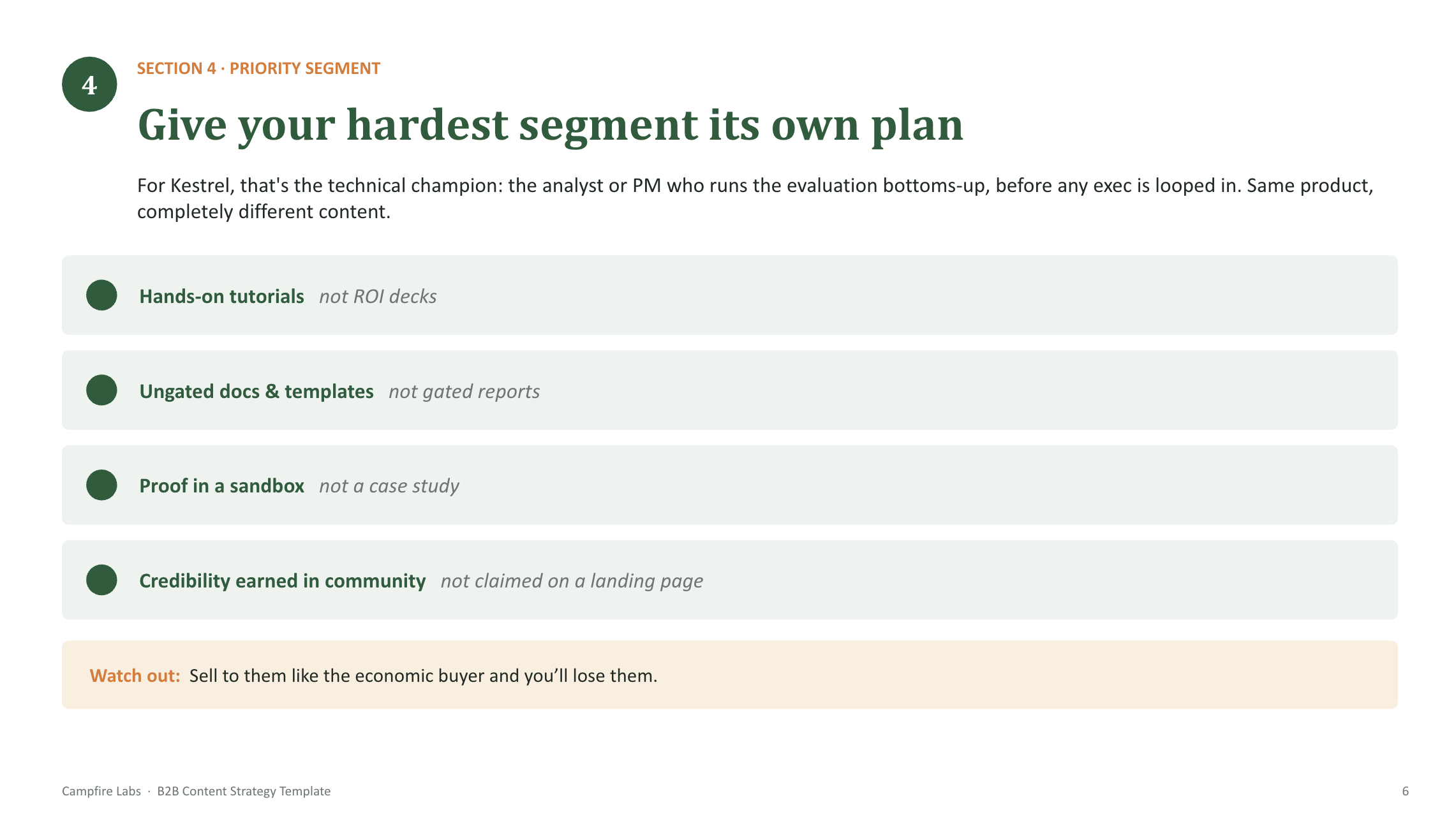
For our hypothetical company Kestrel, that's the technical champion—the data analyst or PM who actually runs the evaluation, bottoms-up, before any exec is looped in. Same product, completely different content: hands-on tutorials instead of ROI decks, ungated docs and templates instead of gated reports, proof in a sandbox instead of a case study, credibility earned in community instead of claimed on a landing page. If you sell to that person like they're the economic buyer, you'll lose them in the first paragraph.
Nearly every B2B company has one of these segment types. It might be the champion you keep addressing as if they sign the contract, or perhaps the competitor's frustrated user who needs a different entry point than a cold prospect. This section requires you to name the high-value or hard-to-reach segment and design for it intentionally, instead of hoping the general program happens to catch them.
If your strategy treats all buyers as one audience with one journey, this is usually the section that catches (and hopefully fixes) that flaw.
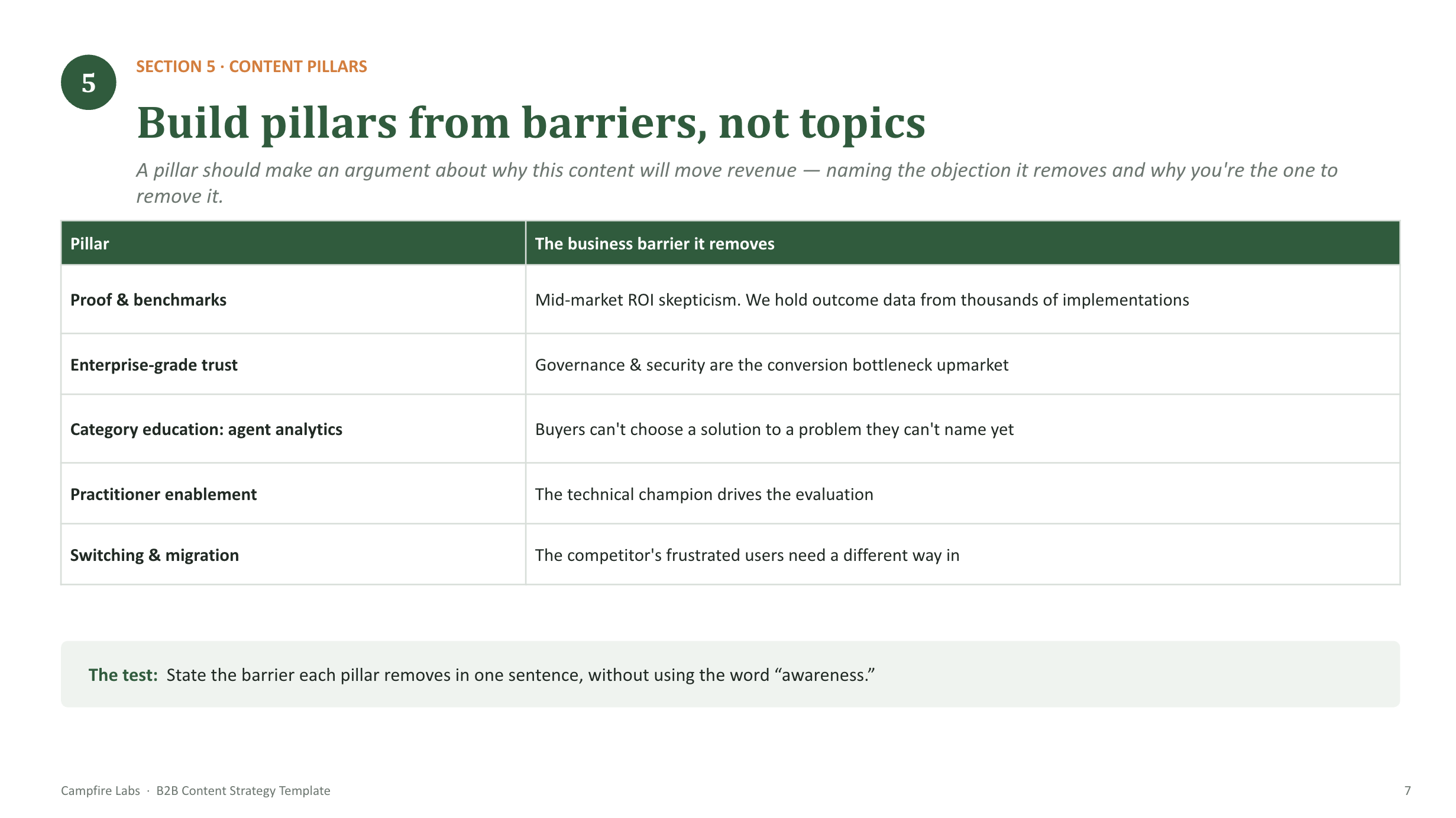
The fifth section covers content pillars, each justified by a business barrier rather than a subject.
What do we mean when we say pillars need to align with business barriers? Well, a topic-based pillar looks like "analytics best practices." A barrier-based pillar looks like "proof and benchmarks, because the mid-market majority is skeptical of analytics ROI claims, and we're the only vendor sitting on outcome data from thousands of implementations." Basically, a pillar should make an argument about why this content will move revenue.
Applying this to Kestrel's pillars: "Enterprise-grade trust—because data governance and security are the conversion bottleneck upmarket." "Category education for agent analytics—because buyers can't choose a solution to a problem they don't know has a name yet." You could delete the topics and still know exactly why each pillar exists.
This is the test for your own pillars: can you state the business barrier each one removes, in one sentence, without using the word "awareness"? If a pillar only justifies itself as "educating the market" or "building authority," it's a topic masquerading as strategy. The strongest pillars name a specific objection and a specific reason you're the one who can answer it; which is also, not coincidentally, the two-lane logic of trust-building and reach-building working together.
The sixth section turns pillars into a plan: each content idea mapped to the ICP it serves, its funnel stage, where it gets distributed, and what format it takes.
Kestrel's version is a set of tables, one per pillar, listing specific assets, which segments they apply to, who they're for, where they'll be distributed, and the content type. This could be a benchmark report as a gated lead magnet for the skeptical mid-market majority, or ungated tutorials and a template library for the technical champion. We'd also include a "what is agent analytics" explainer hub to build the new category from scratch.
Built this way, the strategy doubles as a prioritization tool. You can see at a glance which pillars are overstuffed, which segments are underserved, and which channels are overloaded.

Those six sections are the strategic core. But a mature SaaS content program needs a few more layers on top before it's something a team can actually run.
Add these before you call your strategy complete:
The barrier-first thinking is what makes the strategy strategic; these six additions make it operable. Make a copy of the template and get started! And feel free to reach out to Campfire Labs if you need a strategic partner on content this quarter.
Subscribe to our newsletters for insights, ideas, and perspectives from the brightest minds in marketing, delivered straight to your inbox.
