
July 14, 2026

Competitor pages, data-driven research, podcasts, social, and case studies so good you should steal them (ethically, of course)


This article is part of a series in which we round up great examples of classic types of content. Check out our case study examples, benchmark report examples, content strategy examples, or thought leadership examples.
The fastest way to get better at content isn't another framework or another webinar. It's studying work you admire, figuring out the mechanics, and stealing them.
That's the whole premise of this piece. We've collected 21 B2B content marketing examples we love—competitor comparisons, data-driven research, podcasts, thought leadership, design, social, and case studies—and pulled out the specific move each one makes that you can take for yourself.
A few of these examples are our own work with clients, and they're here because they're the pieces we know most intimately, not because we made them. Okay, also partly because we made them...
Comparison pages and alternatives posts are the least glamorous content on your site, and usually the highest converting. The reader is already shopping. The only question is whether you help them decide.
Mixpanel doesn't argue feature-by-feature parity with its biggest rival. Instead, the page frames the entire comparison around the axis Mixpanel wins on: speed, ease of use, and cost, positioning Amplitude as the heavier, pricier tool for teams that want to trade speed for depth. That framing gives the competitor its due, which is why the rest of the page reads as credible.
Steal this: pick the battleground where you win, and fight only there.
2. The 7 best Amplitude alternatives
Mixpanel's article ranks itself alongside six real competitors—Heap, Pendo, and others—and gives each an honest assessment of where it fits. Once again, the candor is the tactic. Someone searching "Amplitude alternatives" is in critical evaluation mode and will click away from a self-serving list instantly. But an honest list earns the click-through.
Steal this: when search intent is high, honesty converts better than salesmanship.
Book a call with our CEO to talk through your B2B content needs.
3. Ramp Economics Lab
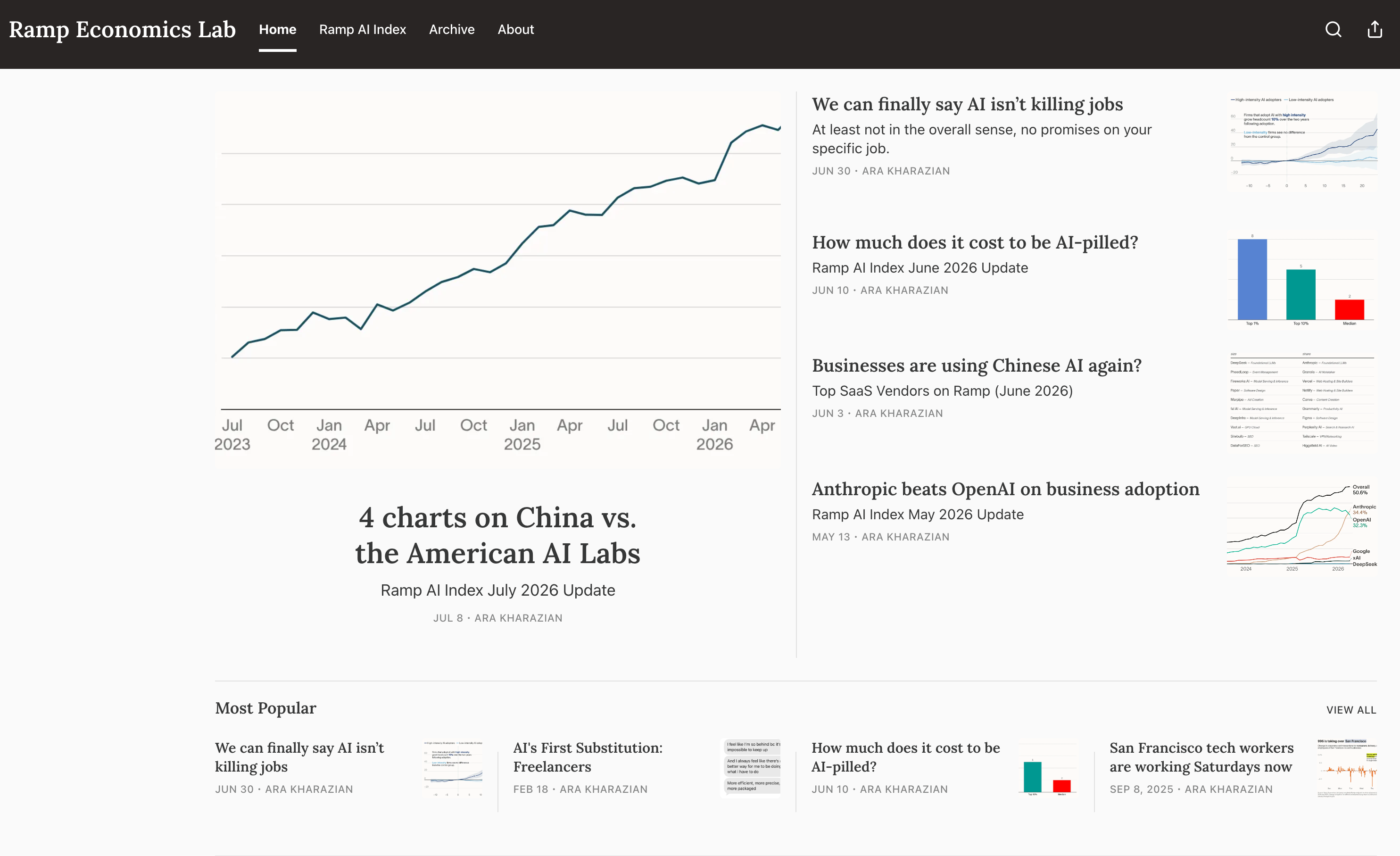
Ramp did something most B2B companies only gesture at (and can only dream of): they hired an actual economist, Ara Kharazian, and turned their corporate card and bill-pay data into a genuine economic publication. The Econ Lab Substack publishes data nobody else has. The Ramp AI Index has become the reference dataset for tracking business AI adoption: it lives on the Bloomberg Terminal and has been cited by the Federal Reserve, the Wall Street Journal, and the Financial Times. And the Top SaaS Vendors series jumps into live industry debates with headlines like "Claude didn't kill design apps."
One proprietary data set turns into several different owned channels, increasing distribution and coverage.
Steal this: build one data product you can publish on a regular cadence, not a scatter of one-off reports.
4. Campfire Labs' SEO content benchmarks
Generalized benchmarks are about as useful as a screen door on a submarine, so we analyzed organic traffic for 500+ B2B SaaS companies and published growth benchmarks for seven specific verticals. A content lead at a marketing software company can aim for roughly 6% monthly organic growth; in customer service software, 1% is a win. Different verticals, different definitions of "good."
Steal this: go more specific and narrow in who your data insights are for, not wider.
5. The backlink myth, tested
We set out to prove that data-driven content earns more backlinks than standard guides. The honest answer was no—and we published it anyway, along with the more interesting finding underneath: the links data-driven content does earn are a different quality entirely.
Steal this: a published "no" buys more trust than a convenient "yes."
The best B2B audio and video programs behave like media properties—recurring, hosted, aimed at a specific audience—rather than marketing assets with a launch date. (We've written about how to make B2B video sustainable when your team is already stretched.)
Cvent's podcast is hosted by Cvent's own people—Rachel Andrews, Alyssa Peltier, and Felicia Asiedu—and made for event professionals, which is exactly who buys Cvent. Episodes ship every other week, and have for years. No celebrity guests, no growth hacks. Just a consistent show for a precise audience.
Steal this: your ICP is a beat, so cover it like a newsroom would.
7. Reveal: The Revenue Intelligence Podcast by Gong
Gong put sales leaders at the center of the show and kept the product at the edges. The result did category work no ad spend could: "revenue intelligence" became vocabulary buyers used because the show gave them hours of reasons to. It's the audio version of naming the conversation you want to own.
Steal this: make your customers the protagonists and your category becomes the setting.
The difference between thought leadership and a how-to guide is personal experience. Ahrefs' Ryan Law writes in first person, shows his actual process, and takes positions while they're still uncomfortable. Three examples we enjoyed:
8. How I Do Content Engineering with Claude Code
A senior marketer at a major SEO company opening up his real workflow, tools and prompts included. The generosity is the credibility.
9. On-Page AEO: 4 Writing Frameworks for Better AI Visibility
Ryan coins frameworks for a discipline that barely has a name yet. Naming things is how you end up owning the conversation about them.
10. My Complete AI Content Process for Ahrefs
Published while most content teams were still hedging about whether they used AI at all. Timing is a position, too.
Steal this: write what only you could write, in first person, before it's safe.
11. Adobe's "Make It" event asset kits
For its global "Make It" event series, Adobe's B2B team used Express to build more than 150 assets from around ten templates. Design-as-system means one strong template family does the work of a hundred one-off requests. (It's also dogfooding as proof, which beats any product page.)
12. The Express template library as content
Adobe Express's search-optimized template pages function as top-of-funnel content that drops users directly into the product. This is the play driving organic growth across the design software vertical; it's also one of the clearest patterns in our benchmarks data.
13. Dentsu's distributed design operation
Adobe's Dentsu story shows the system at enterprise scale: teams across roughly 120 markets shipping on-brand social content, newsletters, and campaign assets 70% faster, with the central creative team freed up for strategic work.
Steal this, from all three: treat design as a repeatable system, and let one hard number anchor the aspiration.
Book a call with our CEO to talk through your B2B content needs.
Since 2024, organic reach for LinkedIn company pages has fallen more than 60% by one practitioner's analysis, while personal profiles pull several times the engagement. Attention has moved to people, and with most searches now ending without a click, your buyers are forming opinions in their feeds long before they reach your site. We went deeper on this in our social content examples roundup; here are the two we'd steal from first.
14. Exec-led LinkedIn
I used to hate posting on LinkedIn. But the Campfire team coached me out of it with three rules: show up consistently instead of chasing virality, use my actual voice instead of the corporate bullshit generator, and treat LinkedIn as a community rather than a megaphone. The results: 1,666% year-over-year engagement growth, 200% impression growth, 26% follower growth.
Steal this: make consistency the target. When the target is "go viral," you freeze.
15. Oyster's employee-led social
Oyster looked at which employees already matched their ideal customer—global People and HR leaders—and backed those individuals as voices on LinkedIn. A People director's rant about companies writing policy "for the worst 5%" cleared 300+ reactions, because practitioners trust practitioners, and those employees' networks are full of the exact buyers a corporate page will never reach.
Steal this: your best distribution channel might already be on payroll.
Formulaic case studies get published, sit on a website, and get pasted into a proposal twice a year. These four each commit to a distinct approach—we broke down what makes each type work in full.
16. Elephant Energy — the narrative case study
Richard and Rosemary's story opens with a $450 heating bill and a furnace that scared its owner, and lands on the moment he opened a $0 electric bill. The customer's voice carries the entire piece; the vendor is barely there. That's what earns trust before the demo call.
176. Pleo × Laffer Abogados — the lifecycle-moment case study
Pleo's story covers one stage of the customer journey—onboarding—and nothing else. No headline metrics, all qualitative reassurance, aimed at the exact moment buyer anxiety peaks. One moment done with depth converts better than three done at surface level.
18. Netradyne × Knight-Swift — the video case study
The page is essentially a headline, a CTA, and one embedded video of a safety manager from one of North America's largest trucking companies vouching for the product on camera. It's much harder to assume a quote was manufactured when you can watch the person say it.
19. Mixpanel × Movember — the impact-led case study
Three comparative metrics—all versus GA4—before you've scrolled at all. Buyers evaluating vendors under time pressure skim, and comparative numbers need no translation: if you're on GA4, you already know what "28% more traffic captured" means.
Steal this, from all four: pick one way to tell the story and commit to it completely.
Every example here made one clear choice and committed to it. Mixpanel chose a battleground, Ramp chose a cadence, Cvent chose a beat, Pleo chose a single moment in the customer journey and ignored everything else. It's so easy to be scattergun with content, but these examples are all defined by their focus and commitment.
Pick the one format your team already produces—case studies, social, comparison pages, whatever ships next month—and reverse-engineer one mechanic from the example above it.
One choice, fully committed, beats five formats done at surface level. If you want a partner to help make that choice, talk to the team at Campfire Labs.
Subscribe to our newsletters for insights, ideas, and perspectives from the brightest minds in marketing, delivered straight to your inbox.
