

March 2, 2026

The hub-and-spoke model had a good run. Here's the two-lane framework replacing it.

The best content marketing teams are doing two things that seem like competing priorities, but they’re actually a strategic response to the fractured content landscape of 2026.
These teams are investing in hyper-personal, completely unscalable executive thought leadership—actual humans with actual opinions, posting on LinkedIn three times a week. And at the same time, they’re spinning up high-volume AI-assisted content, shipping comparison pages, and use-case guides at a pace that would have seemed absurd two years ago.
Each approach serves a different function in the buyer journey. One earns trust. The other earns reach. You need both.
Let’s be honest, the hub-and-spoke model had a realllly good run. Build a pillar page, surround it with supporting content, and watch the organic traffic roll in. It worked beautifully, until it didn't.
AI Overviews now appear in over 20% of search results. That top-of-funnel content you spent weeks crafting? It's increasingly getting answered directly in the SERP, no click required. HubSpot—the company that essentially invented modern content marketing—reportedly lost significant organic traffic thanks to this fundamental change in how search engines answer queries.
Meanwhile, people are still searching and wondering about your brand. It’s just that increasingly, they’re consuming that information offsite, in AI-generated answer boxes or chats. Our job as B2B content marketers is to influence the buying decision on those platforms now. As organic growth advisor Kevin Indig has said, stop optimizing for traffic, optimize for influence instead.
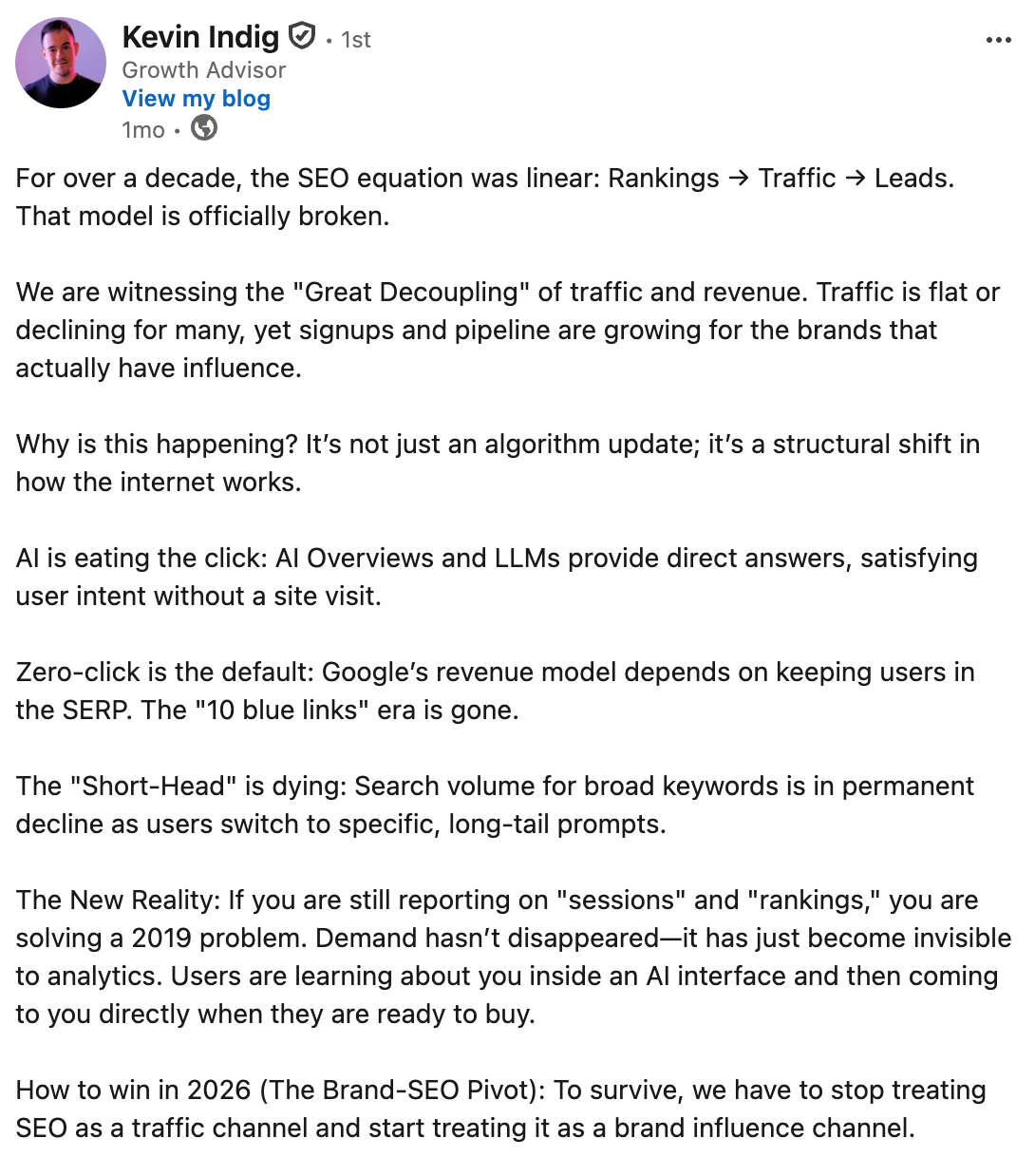
But the old playbook wasn’t built for influence. It was built for traffic. Search-optimized, cookie-cutter guides were engineered to capture clicks, not to build brand loyalty or trust.
Buyers still need to trust someone before they make a purchase, and that trust comes from a human perspective. That’s why executive and employee-led thought leadership has become one of the most important trust-building lanes we can create.
And it doesn’t stop at just building trust. Thought leadership can build pipeline too. Kristen van Laren, Head of Marketing at Peridio, said the company generated $970,000 in quarterly pipeline from executive-driven content.
This all means that B2B content teams need two things at once: scaled content that captures intent at the bottom of the funnel, and human-driven content that builds the trust required to convert that intent into pipeline.
Book a call with our CEO to see how Campfire Labs can develop and execute a content strategy for your business.
Lane 1: Executive thought leadership. This is hyper-personal, inherently unscalable, and fundamentally about trust. It's your VP of Product posting a provocative take on where the industry is headed. It's your founder sharing a lesson learned from a deal that fell apart. It can't be delegated entirely (ahhh if only), but it can be supported with lightweight systems that make it sustainable.
Lane 2: Scaled AI-assisted content. This is high-volume, lower-funnel content: comparison pages, competitor alternatives, "best X for Y" guides, integration-specific landing pages. The kind of content that used to take a week per piece and now ships in hours with the right workflow.
Most executive thought leadership programs die from one of two causes. Either the exec was never bought in, or the support model was unsustainable.
The first problem is often unfixable. If your CEO doesn't get it—if they see LinkedIn as beneath them or can't find 30 minutes a week for it—they're probably not going to change. Find someone else. One authentic voice from a VP or Director who actually wants to be online beats a reluctant CEO being ghostwritten into blandness.
Look for the person who already has opinions and isn't afraid to share them in internal meetings. Did you see someone light up when talking about industry trends or customer problems? Congrats, you just found your Lane 1 candidate.
Finding the right person is only half the equation. Even the most opinionated exec will stall without a sustainable support system that makes it easy for them to get their actual thoughts into the world. We've seen success with this type of workflow:
That's it. The total exec time commitment is 30-60 minutes per week. The content team investment is a couple of hours of coordination and editing. It's sustainable because it doesn't require the exec to stare at a blank page.
Jillian Hoefer, who runs content at UserEvidence, described a similar dynamic when discussing how she approaches thought leadership. "I don't typically go to AI for the ideas," she explained. "I bring my ideas to the GPT. That's what I've found gets us content that doesn't feel generic and kind of AI sloppish." The human provides the point of view; the tools help with execution.
The fear with AI-assisted content at scale is obvious: you'll flood your site with undifferentiated garbage that Google penalizes and prospects ignore. It's a legitimate concern, as we've all seen the cautionary tales of companies that published thousands of AI-generated pages and watched their traffic crater.
Avoiding becoming a slop-producing machine starts with feeding AI original, expertise-backed ideas. The teams getting Lane 2 right anchor every piece with information they own, such as proprietary data, customer insights, operator perspectives, and human editorial oversight.
Jillian's team at UserEvidence runs quarterly original research projects specifically so they have proprietary data to feed into their content engine. "If you're going to be using AI to create content," she noted, "you have to have some proprietary information to feed into it to have a unique angle. That ensures it's not just pulling slop from other places, including your own competitors."
They built what she calls a "content concierge" (a GPT bot loaded with their proprietary research data) and every piece of content they produce runs through it to pull in relevant stats and proof points. The result is AI-assisted content that's still differentiated because the underlying data can't be replicated by competitors using the same tools.
Once teams start getting the hang of using AI to produce unique content, it's time to consider which AI-assisted assets to prioritize.
Start with BOFU, not TOFU. Think comparison pages, alternatives pages, "best X for Y" guides; this is where AI-assisted scale makes the most sense. The intent is clear, the format is somewhat standardized, and the conversion potential is highest. Save the nuanced thought leadership for Lane 1.
Find out how to show up in LLMs.
At Campfire Labs, we've partnered with clients to put this two-lane approach into practice over the last six months. The teams that see the greatest success are those who find ways to make both tracks reinforce each other by doing things like:
The scaled content gets more credible because it's anchored in a real human perspective. The thought leadership gets more reach because it's being atomized and distributed across the content engine.
Book a call with our CEO to see how Campfire Labs can develop and execute a content strategy for your business.
"We don't have bandwidth for two strategies."
We hear you. But we'd counter by saying that this two-lane approach often takes the same or less total effort than the old TOFU-at-scale approach.
Lane 1 is 30-60 minutes per week from one exec, plus support time. Lane 2 is AI doing what used to take weeks. The combined output can be higher while the total human effort is lower or equal to before, as long as you've invested in the proprietary inputs (research, interviews, customer stories) that make the AI output worthwhile.
The other objection: "Thought leadership doesn't have to be exec-written." That's true. Proprietary research, event content, and authentic customer stories can all fill Lane 1. The key criterion is that it can't be replicated by AI because the underlying insight hasn't happened yet. It comes from real conversations, real experiences, real opinions.
Have one conversation with an exec this week. Don't pitch a content strategy. Don't show them a calendar of posts. Just ask these questions:
Their answers tells you whether Lane 1 is viable with this person. It often surfaces the first 3-4 post ideas. And it shifts the dynamic from "content team asks exec for a favor" to "content team helps exec say what they already want to say."
The two-lane model isn't complicated. It's just honest about what the current landscape requires: human trust at the top, machine scale at the bottom, and systems that connect them.
Subscribe to our newsletters for insights, ideas, and perspectives from the brightest minds in marketing, delivered straight to your inbox.
