
August 26, 2026

From Vanta to Clay, here are the B2B content marketing examples we're crushing on right now.


A few weeks ago, Fio Dossetto asked her LinkedIn network a simple question: what's your current B2B brand crush?
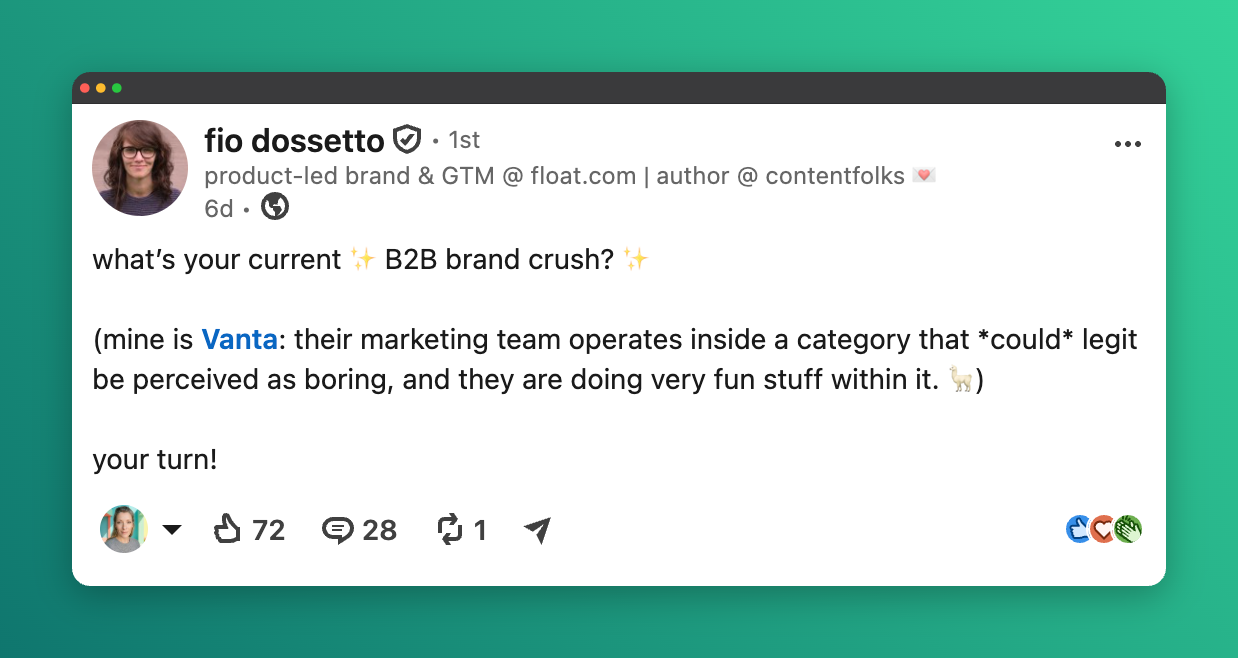
Seventy-two reactions and twenty-eight comments later, the thread had turned into an absolute treasure trove of inspirational content. Content folks jumped in to name the companies whose marketing they've been drooling over, repeatedly citing Vanta, PostHog, Rippling, and Clay. One commenter admitted to being so obsessed she follows their YouTube channels for fun; another said she'd voluntarily watched Vanta's security awareness training and enjoyed it, which, if you think about what security awareness training normally feels like, is a small miracle.
The Campfire team couldn't resist digging into the content strategies behind these recommendations to see why B2B marketers are crushing on these brands. For each one, we've tried to identify the mechanism underneath (the repeatable thing they do that we can all learn from, not so much individual campaigns), plus a note on what it would take to run a version of it yourself.
Compliance software is a category that could easily be dull. Vanta decided it wouldn't be.
Their rebrand put a llama at the center of the brand, which sounds like a small thing until you notice how much work a mascot does in a category where every competitor is using shield icons and navy blue (AI companies with cat-bum logos, take note).
Underneath that, they've built a super disciplined SEO structure around dedicated subfolders for SOC 2, ISO 27001, GRC, HITRUST. These account for the majority of their top-three rankings and pull tens of thousands of organic visits a month, according to Foundation's teardown. Those same pages show up across AI Overviews and ChatGPT citations for evaluation-stage queries.
The mechanism: a serious search moat plus a brand that gives people permission to enjoy the topic, personified by a fun mascot.
The portable version: pick the least glamorous concept in your category (the one your buyer dreads, like content leaders dread ROI conversations…) and give it a name, a face, or a running joke. Pair with a solid GEO/SEO moat, kind of like the two-lane strategy we've spoken about before.
Most B2B video is a webcam, a slide, and someone reading a script. Probably awkwardly.
PostHog's YouTube channel looks like an influencer's, not a B2B team's work. Their video "The attack everyone warned about just happened" is a great example: a reactive take on a breaking developer-world story, paced like something from a tech YouTuber. The lack of brand intro or product pitch makes the content feel like the kind of thing a developer sends to another developer.
That style vibes with their video handbook, which says the team operates as "content creators, not a marketing department," and that they benchmark against popular YouTube creators, podcasts, and viral social, not against competitors' videos.
The second thing they do well is have actual opinions. PostHog publishes strongly held, counterintuitive opinions from the engineers and operators on their own team: for example "40 things we've learned about marketing for developers" takes positions plenty of marketers would argue with. Their content handbook lists "opinionated advice" as a content type, alongside a stated refusal to run gated PDFs, webinars, freelancers, or AI-generated posts. (That handbook being public at all is a nice trust signal.)
The mechanism: speed, plus a real expert with a real position. Newsjacking only works if you can ship in hours rather than weeks, and it only lands if your takes are worth tuning in for.
The portable version: find the one person on your team with genuinely spiky opinions about your category (usually an engineer or a founder, rarely a marketer, unless you're looking for marketing takes) and build a lightweight format around getting those opinions out within 72 hours of something happening. The production quality matters less than the speed and the stance.
Ramp's Super Bowl 2026 spot certainly got attention, but felt out of reach for the vast majority of B2B SaaS content budgets. Not all of us can afford a six-hour livestream in a glass box in Manhattan with Kevin from The Office manually filling out expense reports. I certainly wish the Campfire content budget ran to those kind of campaigns.
Thankfully, perhaps the more effective aspect of Ramp's content strategy is (somewhat) more achievable. They employ a lead economist, Ara Kharazian, who publishes the Ramp AI Index, the Advertising Index, and the Econ Lab newsletter, using the company's own transaction data. That analysis gets cited by the New York Times, the Wall Street Journal, the FT, Bloomberg, and NPR, backlinks I'm sure we'd all love to have.
The mechanism: proprietary data published on a schedule, by a real human with credentials.
The portable version: you almost certainly have data nobody outside your company has seen. Pick one metric your customers would find genuinely interesting, commit to publishing it quarterly, and put a real person's name on the analysis. (Not sure what you're sitting on? Start with a content data audit.)
Wondering whether data content drives more links?
Clay went from $1M to $100M ARR in two years, and most of the credit goes to the product, the community, or the general GTM noise around them. The SEO content architecture underneath gets talked about less, but it deserves a shout-out too:
The mechanic: every page belongs to a pillar, and every pillar has one job. Most content libraries grow by accretion, as in a page gets made because someone asked for it. Clay's SEO content foundation appears to be much more intentional than the average.
The portable version: find the one tedious, repetitive thing your buyer currently does in a spreadsheet, and vibe-code an ungated tool that does it. Optimise for tool-specific keywords and add a demand capture mechanism on each tool page you create.
Air, a creative operations platform, has a wonderfully high tolerance for weird. They ran a New York Times ad that was a handwritten letter from CEO Shane Hegde with the headline "AI would never smoke a cigarette with you" and his actual cell number. They staged elderly actors protesting outside an Adweek conference with signs reading "Dropbox needs botox." They built Silicon Gables, a parody site positioning legacy software as a retirement community, complete with a care hotline. They put kidfluencer the Rizzler in a B2B ad with comedian Kareem Rahma dressed as Steve Jobs (I know, it's hard to picture, but trust me, it happened).
Head of Content Ariel Rubin reports directly to the CEO, with no layer in between, and grew the team from two to twelve. Marketing spend dropped 90% while revenue tripled.
The mechanic: short approval chains mean the most creative ideas get made, instead of dying in lengthy review cycles.
The portable version: ask for one campaign a quarter that skips the usual approval path, then get creative.
Listen, who doesn't have an HR horror story?? And no one has more of them than HR teams themselves (trust me, I was a People Ops leader for a while and ohhhh boyyy).
That's why Rippling's out-of-home campaign, which turned real HR horror stories into 3D miniature dioramas, resonated so deeply with the target audience. From the employee who brought an emotional support clown to his own dismissal meeting to the person who photocopied his own feet, the stories were rendered in miniature, across stations, taxis, radio, and social, with a website inviting people to submit their own.
The mechanic: your customers' war stories are the campaign. Rippling didn't invent the material, they just leveraged it to create a sense of community and brand resonance.
The portable version: spend an afternoon in the subreddit or Slack community where your buyers complain. The best five stories you find are worth more than any brainstorm.
UserEvidence's Evidence Gap report is such a great example of survey-driven content done right.
Alex Eaton from UserEvidence's marketing team explains how they went about it:
"We started by outlining the story we wanted the report to tell. What was the dream claim we wanted to make? Once we had our vision, along with a hypothesis and a few potential headlines for the report, we worked backward to identify the data we'd need to tell that story and the questions we'd have to ask. — Alex Eaton, VP Marketing at UserEvidence
They surveyed 619 respondents, spent a month on analysis and design, and, in the final hours before launch, sent the draft to people with relevant audiences and asked for reactions to specific findings. 700+ downloads in 30 days and a HubSpot feature followed.
The mechanic: build distribution into the artifact before it ships. Getting quoted in a report is a much better ask than "please share this."
The portable version: whatever you're publishing next quarter, identify ten people whose audience you want and quote them in the asset, then encourage them to share it.
Sybill is the smallest company on this list and at first I was like "who?" when reading the comments on Fio's thread. But I went and checked them out, and thus fell in love with their unapologetic approach to BoFU coverage.
Their blog is full of the comparison pages you'd expect: Sybill vs Gong, Sybill vs Fathom, Sybill vs Fireflies, yah dee yah. But it's also full of comparisons they have no direct stake in: Gong vs Granola, Gong vs Fathom, or Granola vs Fathom. They're publishing the neutral referee content for their entire category, capturing high-intent buyers at the exact moment those buyers are comparing two other vendors and positioning themselves as a go-to info source.
We often recommend BoFU comparison content to Campfire Labs' clients, but we've never gone as far as doing comparison content in which the client doesn't even feature. It's something I'd be interested in testing now.
The mechanic: own the whole comparison map, not just the pages you appear on. Every "X vs Y" query in your category is a buyer with intent.
The portable version: list every meaningful competitor pair in your space and cover comparisons and alternatives from every search angle. The search volume on each may be small, but the intent is massive.
Not all of us have a CEO who'll put his cell number in the New York Times, or a Series C balance sheet.
But I believe we can still learn from the spirit of these eight content marketing examples. All of them find a point of leverage specific to their situation—a two-person approval chain, a data set nobody else has, a willingness to write about competitors—and lean into it.
Leverage is available at any budget; it just requires you to be honest about which kind you actually have.
My recommendation would be to pick the company here whose constraints look most like yours and run the smallest version of their mechanism once. It could be three comparison pages, a vibecoded ungated tool, or an afternoon spent in the subreddit where your buyers complain. Who knows, when Fio asks everyone for B2B brand crushes next year, your campaign might make the list.
Subscribe to our newsletters for insights, ideas, and perspectives from the brightest minds in marketing, delivered straight to your inbox.
